The Real AI Gap
Why broad AI adoption and almost-zero workflow integration are two different things — and which one is actually costing you.
The Practical AI Playbook for Small Business
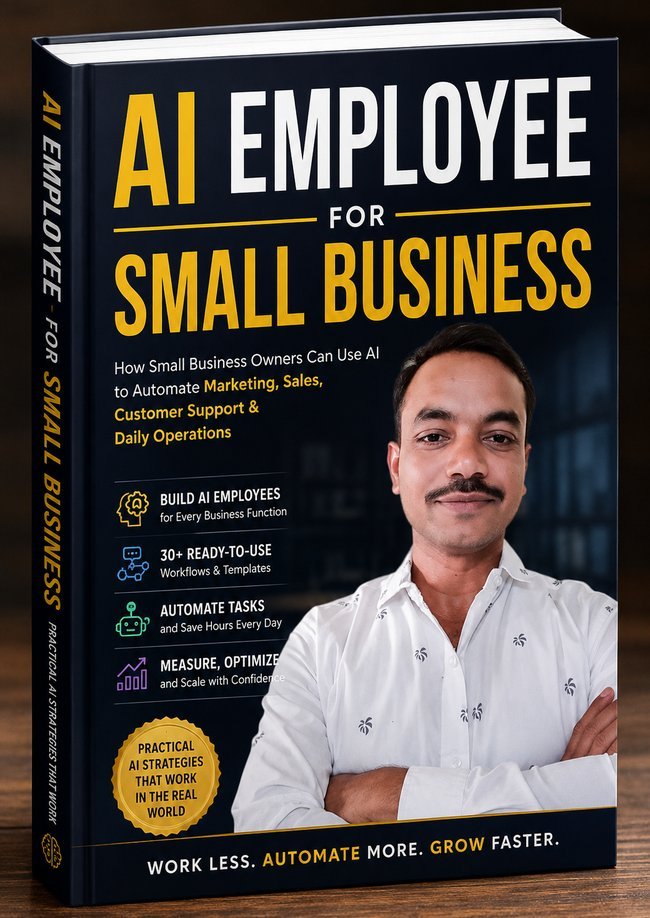
AI tools are everywhere. But most small businesses still use them one conversation at a time — open a chat window, ask a question, copy the answer, close the tab, repeat tomorrow. AI Employee for Small Business shows you how to turn repetitive business work into repeatable AI-powered workflows: a defined process, a human checkpoint, and a number that tells you if it's working.
The Real Problem
Most small businesses have already adopted an AI tool. Very few have built anything that keeps running once the chat window closes. That gap — not access to AI — is what's actually costing you the advantage.
The AI Employee Stack
This isn't another prompt list or AI tools tour. Every chapter turns one piece of real business work into a defined role — using the same six-stage stack every time, regardless of which AI tool you use.
Three more frameworks build on this one throughout the book: the Risk Gate & Opportunity Score (what to automate first, and what to keep permanently human), the Human vs. AI Responsibility Matrix (how much review any task needs), and the Workflow Maturity Model (how to tell if a workflow is actually improving).
Inside the Book
Not a tools list, and not a prompt collection — a structured path from picking the right first task to running a measured, automated workflow.
Part I — The Gap
Why broad AI adoption and almost-zero workflow integration are two different things — and which one is actually costing you.
The vocabulary — and the AI Employee Stack — that the rest of the book runs on.
The Risk Gate and Opportunity Score: how to pick your first task by evidence, not excitement.
Part II — The Four AI Employees
Social content, review responses, and Google Business Profile updates — built as a standing role, not a task you remember to do.
Lead follow-up, quote follow-up, and complaint triage — the highest-return workflow category in the book.
Turn tribal knowledge into a real SOP, and competitor research into something you can actually act on.
Monthly reporting and feedback analysis that takes minutes instead of an afternoon.
Part III — Connecting & Governing
Trigger, action, connection — tool-agnostic, so the method outlives whichever platform you use today.
Exactly how much review any given task needs — and which tasks should never run unsupervised.
Part IV — Measurement
The Workflow Maturity Model — how to prove a workflow is improving instead of just running.
Part V — Implementation
Every framework in the book, applied day by day, to one real workflow in your business.
Real Workflows From the Book
22 workflows in total, each with a ready-to-use prompt template. Here are ten of them.
Follow-up happens only when the owner remembers — most quotes just go quiet.
Staged follow-ups at defined intervals, reviewed, with a clean close instead of open-ended limbo.
Reviews sit unanswered for days, or only get a reply when they're upsetting enough.
Consistent, on-brand drafts for every review — negative ones always routed to a human before posting.
Posting happens in bursts when someone remembers, then goes quiet for weeks.
A week's worth of on-brand drafts, ready for a quick review before scheduling.
Processes exist only in someone's head — and leave when they do.
A structured, expert-reviewed SOP that survives an employee leaving.
Knowing what's overstocked or dead stock means digging through spreadsheets nobody has time for.
A flagged list of what to reorder, discount, or discontinue — reviewed before acting.
Knowing which products or channels actually drive margin takes more time than most owners have.
A ranked summary of top and bottom performers, with trend notes.
The same issue can recur for months before anyone notices it's a pattern, not a one-off.
Feedback grouped into themes, with recurring issues flagged before they become a bigger problem.
Every customer gets the same outreach, regardless of value or frequency.
Customers grouped by frequency and value, so outreach effort matches who's actually worth it.
Reporting takes a Sunday afternoon — if it happens at all.
A short, readable summary generated the moment the month's data is exported.
Quotes get sent and then followed up inconsistently, if at all.
Quote-specific follow-ups that surface the real objection instead of a generic "just checking in."
You're Not Just Getting a Book
Every tool below is part of the book itself — not a separate upsell.
A section-by-section inventory of where AI is already used in your business — and where it isn't yet.
Score your own task list on frequency, value, and ease to find what's actually worth automating first.
The exact structure used throughout the book to define a task, its inputs, its approval step, and its KPI.
The 13-field format used for every flagship workflow — ready for the next one you build yourself.
Confirm a workflow's review step is actually designed correctly before you reduce oversight on it.
Week-by-week plan for building your first workflow, then your second and third.
A starting point by business type — retail, salon, restaurant, real estate, and six more.
Works Across Business Types
These are examples of where the book's workflows apply — not a guarantee of results for any specific business.
Each gets a starting point in the Industry Quick-Start Table — the top workflow to try first and a KPI to watch. Your business will still need its own specifics filled in.
Is This For You?
Before You Decide
No. It's written for non-technical owners — the whole framework is designed to be usable through ordinary chat tools and simple integrations, not code.
No. The methodology is tool-agnostic by design, and every chapter marks tool-specific features as "current" versus "stable concept" so it stays useful as tools change. Most workflows run on tools you likely already use.
No prior knowledge required. Chapter 8 explains the trigger–action–connection concept from scratch, and recommends starting with the simplest available integration, not the most powerful one.
Yes — that's the point. The book doesn't require a specific AI platform. If you can open a chat window and use a spreadsheet or email, you can run every workflow in it.
The patterns are reusable across the industries in the Quick-Start Table, but you'll still need to adapt specifics — pricing, tone, and local details — to your own business. No workflow is plug-and-play with zero setup.
That's not what this book teaches. The Responsibility Matrix in Chapter 9 is built specifically to keep a human in the loop wherever a mistake would actually matter — most workflows stay human-reviewed by design.
No — and the book actively argues against it. Chapter 3 and the 7-Day plan are built around choosing one task and building it properly before starting a second.
Customer Stories
We don't use fake reviews. This section will show verified testimonials from actual readers — the first ones are being collected now.
The Offer
Instant PDF download
All sales are final — no refunds. See refund policy for details.
Everything in this book leads to one outcome: a real workflow, built and running in your business, with a number that proves it's working.